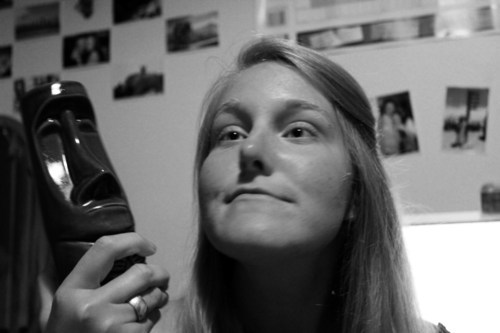
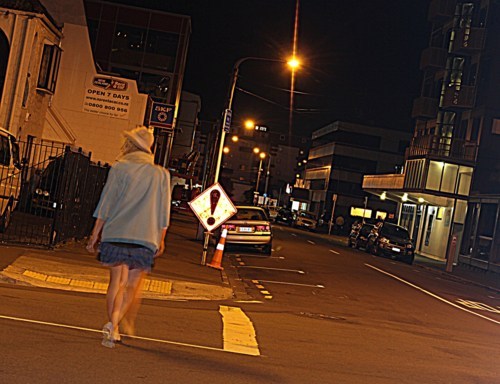
=“The sudden realisation or comprehension of the (larger) essence or meaning of something.”
There are some things in life that we can be told time and time again and yet simply cannot or chose not to believe them. There are those truths barraged at us in a deluge of constant fire from all sides, which fail to permeate our armour. They can pound at the gates of our consciousness, or can gradually attempt to caress and ease us into believing and embracing them. But so frequently we chose to remain an impenetrable fortress of pre-conceptions and sometimes sheer fallacy. We know, on a subliminal level, that what people are telling us is honest, heart-felt, well-meaning and often infinitely valuable, but we, for seemingly inexplicable reasons, are unwilling to acknowledge what we know to be true in our heart of hearts. Sometimes it takes a cataclysmic moment for us to truly and unreservedly accept what suddenly seems a blatant and self-evident truth. These moments are often unremarkable in themselves; a particular quote we stumble across in a book, a passing comment from a stranger, or a sight we encounter during the most routine of activities, but they can illuminate a deeper frame of reference in which the truth is simply undeniable. In a single second we can experience something that can crumble the facade we have tenaciously maintained, and we can finally gain a holistic and applicable understanding of what has been impressed upon and explained to us throughout our entire lives. It is often in the places we least expect to, that we find the most profound truths.
Self-belief is one of those truths. To believe that you are beautiful, fabulous, and valuable is one of the hardest things in human existence. Our modern world has seen a proliferation of inspirational media, of blogs, books, music- all attempts to impress upon us our own magnificence. A multitude of can-do literature insists that we can achieve anything, that we can surmount the proverbial Everest in our lives, that impossible is nothing. Yet, no matter how many tales of astonishing audacity we may hear, how often it is asserted that everyone is special in their own unique way, we, as humans, remain fundamentally insecure. A compliment can sit pertinently with us, but one irking negative comment too can consume and fixate us.
“Tall poppy syndrome” needs no introduction. It is, everyone from our politicians to our primary school teachers reiterates, a plague upon our nation, a debilitating and progress-hindering characteristic of our people. Indeed, I think New Zealand is an inherently, and sometimes overly modest nation. We find it hard to accept compliments and insist that we are undeserved of praise even to the point of ridiculousness. There is almost a social obligation to appear modest and to keep our accomplishments quiet so as not to show disdain. But why? It seems that we could benefit from lifting our chins up with the certain pride and imperviousness that Sophie Ward claims serves New Yorkers well it seems.
 In my opinion, this syndrome of cutting down our most blossoming is in decline, but it remains a damaging and deeply etched imprint on our psyche. I think that my greatest exposure to tall poppy syndrome occurred during my early life in small, rural and isolated Ongarue. I remember a time when it was phenomenally “uncool” to do well in school, and the phrase “try-hard” became generically derogatory. I spent the latter of my primary school years desperately trying to adjudicate a balance between what I knew I could achieve and adopting a rebellious, apathetic persona. I would put on a front of deliberate laboriousness in doing my maths work and walk with my friends during cross country training when I knew I loved to run.
But, at least increasingly, in the real world it’s not cool to play dumb anymore. We have developed an almost congenital paranoia that people will judge us for being ourselves, and for expressing confidence in our own abilities when, at least on the majority of occasions, I like to hope this is no longer the case. Maybe this is my inherently optimistic side liberal Wellingtonian self in full voice, but, increasingly, it’s not homosexuality that’s frowned upon, but homophobia. Intelligence is highly regarded, success to be aspired to, hard work admired, and self-confidence can be sexy without being arrogant.
That isn’t to say that modesty isn’t virtuous. Our down-to-earth nature is something that New Zealanders can, and should take pride in, but we should not become a nation of self-apologists. Humility is becoming, yes, but being a shrinking violet is not.
___________________________________
So, what was my epiphany?
Until recently when people told me, “he’s not out of your league,” “there’s no such thing as leagues” their well-intentioned words fell deaf on my ears as I ascertained that they were simply “being nice.” Undoubtedly they were trying nobly to bolster my confidence while painfully aware that I was destined to fall victim to the inevitably unrequited pangs of the heart. Ironically, words of wisdom from one of the very people I designated as “way out of my league” were the beam of truth that finally and fundamentally challenged my obstinate intransigence - my moment of realisation.
While I may live to be humbly disproved I am finally convinced that “leagues” are a crazy and obsolescent, if not obsolete, relic. The notion of 'leagues' is no more than a convenient lens through which to view life and relationships, without having to address the realities of each individual situation. By dismissing someone as 'out our league,' routinely labelling a task as ‘too hard,’ or a goal beyond our reach it makes it easier to ignore the real, individual and sometimes incomprehensible, or even hurtful reasons why things may not transpire as we envision. And indeed, reality is such that our feelings may be unrequited, or we may not achieve what we had initially aspired to. But by attributing an outcome in relationships (or lack thereof) to an overarching and unchallengeable principle such as "leagues" or "hierarchies" I think people are trying to find simple and blanket explanations for complex and unique situations that we often find hard to understand.

In a way, I certainly at least, have tended to use the notion of leagues like a security blanket. By convincing ourselves that something is unattainable we are anesthetising ourselves to the pain of shattered expectations. Yet, at the same time, if we approach life/situations with a defeatist attitude or preordained sense of inadequacy, it can too easily and become a tragically self-fulfilling prophesy. Dismissing ourselves, our worth and our prospects is not only to undermine the fundamental principles of equality, liberty, and socially mobility that have shaped some of the most valiant battles history and become the celebrated hallmarks of modern society, but it is the death knoll of proactivity, self-improvement and progress. Where would Cinderella be if she had never gone to the ball?To accept the notion of leagues is to solidify oneself rigidly on an artificial social stratification, in which we convince ourselves that we have only certain and limited entitlements. This is false. By are, by virtue of our comparative privilege, endowed with an ability to make of ourselves what we wish.

For a multitude of reasons we may find ourselves hurt or rejected, yet if we never take a chance our hollow negative convictions are given empirical resonance. It is circular logic that is particularly dangerous in matters of the heart. We may shroud ourselves in security blankets of preconceptions and pre-determined failure, but ultimately these blankets are damp and unflattering, serving only to wrap us in self-perpetuating misery and lingering ‘what-ifs?’
 Clichés are written for a reason. It is only through exposing ourselves at our most vulnerable that we are ultimately able to reach the highest pinnacle of strength. It takes braving the cold, the elements, but most of all one’s own self-belief to conquer Everest. Freezing your heart will only confound those irking insecurities which gnaw constantly at you, themselves gaining strength for the next opportunity to rear their ugly head. Mark Twain left us with the impeccable wisdom that “In twenty years time you will more disappointed by the things you didn’t do than what you did do.” Carpe Diem. My four favourite wise men sang that “the love you take is equal to the love you make.” Seize the day. Emmy award winning director Bertram Van Munster observed that “the world is smaller than you think, and the people on it are more beautiful than you think.” Succour all the marrow out of life. Humanity is endowed with an unbounded ability for pleasant surprise. Take a leap. Allow your preconceptions be blown out of the water by something extraordinary. Dream. It’s incredibly refreshing to approach the world with just a little bit of faith. Love. And even if that faith proves unfounded there is remarkable freedom in knowing that you have been unapologetic to your own potential. Live.
I said that we often find the most profound truths in the most unassuming of places. It was Winnie the Pooh who said “...you are braver than you believe, stronger than you seem, and smarter than you think...”